Active bed bug infestations create immense distress for families, but effective remediation relies on thermodynamic physics rather than broad chemical broadcasting. Structural thermal treatment uses portable,…
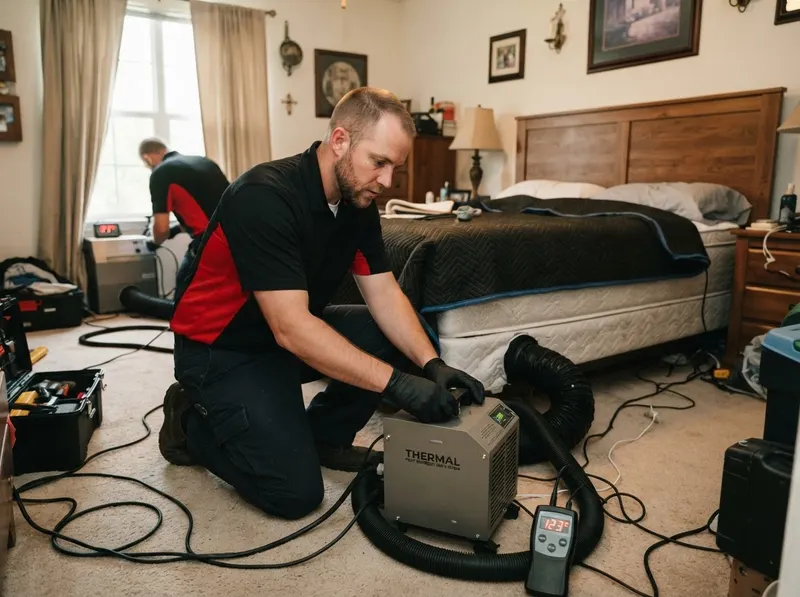
Active bed bug infestations create immense distress for families, but effective remediation relies on thermodynamic physics rather than broad chemical broadcasting. Structural thermal treatment uses portable, industrial convective heaters and specialized axial air movers to circulate air heated between 122°F and 135°F. According to entomological thermal death curves, adult bed bugs die within 15 minutes at 118°F, while unhatched eggs require sustained exposure above 120°F for 60 to 90 minutes. Technicians place wireless temperature sensors deep inside mattresses, upholstered furniture, and wall plates to confirm core penetration across every micro-harborage. Once the thermal cycle finishes and surfaces cool, technicians apply an amorphous silica desiccant dust or low-impact microencapsulated residual along baseboards and electrical chases. This dual approach ensures that any transient pest attempting re-entry across perimeter boundaries contacts an inert desiccant that strips its protective outer waxy cuticle, preventing secondary flare-ups without exposing children or indoor pets to synthetic pesticide vapor.
Building structure influences remediation mechanics across Mecklenburg County neighborhoods. In historic plaster-and-lath homes throughout Dilworth, Myers Park, and Plaza Midwood, thick walls require extended thermal soak periods to reach lethal temperatures deep inside dead air spaces. Modern multi-family condominiums and townhomes in South End and NoDa (North Davidson) require precision perimeter isolation along shared drywall party walls to stop bed bugs from migrating into adjoining residences during heating. For single-family suburban layouts in Ballantyne, University City, Foxcroft, and Cotswold, standard preparation involves clearing loose surface clutter, removing heat-sensitive items such as vinyl records and candles, and isolating luggage from recent travel near the U.S. National Whitewater Center or Charlotte Douglas International Airport.
Selecting a whole-structure thermal remediation strategy fits situations where rapid single-day clearance is necessary to restore sleeping areas immediately. While targeted standalone chemical spot applications cost less initially, pesticide-only methods often require 3 to 4 separate visits spaced across 14-day intervals to catch newly hatched nymphs, as common pyrethroids demonstrate high documented resistance rates and fail to penetrate viable egg shells. The thermal-residual hybrid system demands higher upfront equipment deployment and rigorous home preparation, yet it completes 100% mortality verification within 8 hours. Every treatment plan begins with visual inspection and electronic sensor mapping, with final project investment confirmed on-site based on total cubic footage and clutter density.
Every job gets a firm, written price after a free on-site visit.
Tell us about your bed bug heat and residual remediation job in Charlotte and we'll send a clear, written quote, usually the same day.
 Red Cedar Pest Control